
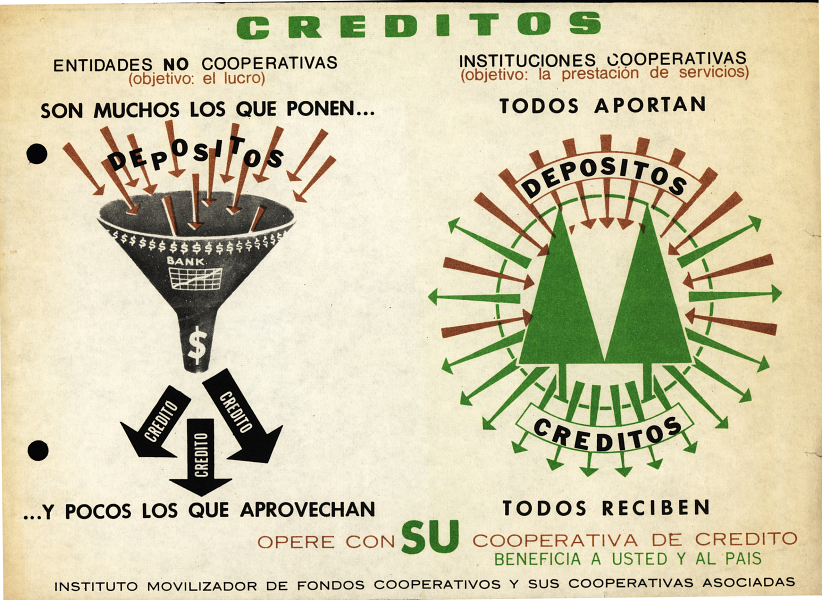

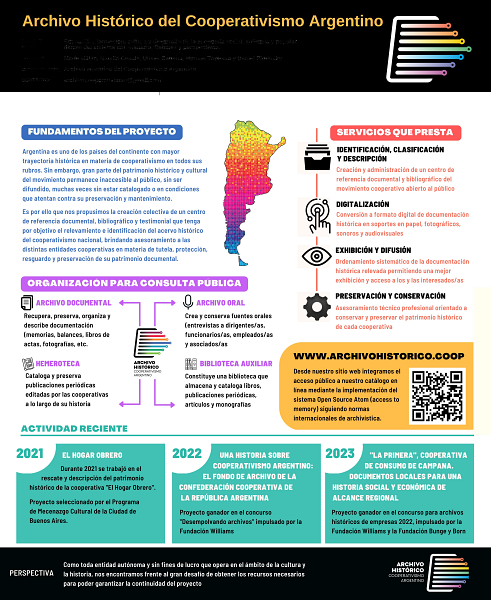
The Archivo Histórico del Cooperativismo Argentino (AHCA), based in Buenos Aires and conceived with national reach, safeguards the documentary memory of a movement that has accompanied Argentina's social and economic development since the late nineteenth century. Emerging from collaboration among the Archivo Histórico del Cooperativismo de Crédito, COOPERAR, the Universidad Nacional de Tres de Febrero and Idelcoop, the initiative brings together documentary collections, periodicals, photographs, oral testimony and information on cooperative archives dispersed across the country. Its oral-history programme, developed over decades, adds the voices of members, employees and leaders to the institutional record.
AHCA's significance lies as much in access as in accumulation: cataloguing, digitisation, archival guidance and a public database turn otherwise fragmented holdings into a common research resource. It thereby preserves the evidence through which cooperative identity can be studied, taught and critically renewed across generations.
The nomination records an oral archive of around 200 interviews with cooperative leaders, employees and members, developed since 1996, alongside the records of bodies such as COOPERAR, El Hogar Obrero and the credit-cooperative movement. That combination matters because formal minutes rarely capture how decisions were negotiated, how members experienced institutions or how cooperation interacted with questions of class, migration, gender and the relationship between town and countryside.
In relation to peace, AHCA's contribution is primarily civic: it preserves evidence of democratic participation, association and negotiated collective action. By making plural memories available rather than promoting a single institutional narrative, it supports a culture in which disagreement can be examined historically and resolved through informed dialogue - one of the less visible infrastructures of social peace.
Featured Criteria
Criterion 1. Historical Significance
Sites must be at least thirty (30) years old, preferably sixty (60), or directly associated with foundational events, milestones, or figures in the cooperative movement.
Criterion 3. Archival, Architectural, or Symbolic Value
Represents milestones in cooperative development. Preserves stories, traditions, or knowledge tied to cooperative evolution.
Criterion 10. Preservation and Safeguarding
Sites shall commit to the safeguarding of cooperative records, artifacts, oral traditions, and buildings through sustainable conservation strategies.
Learn More