
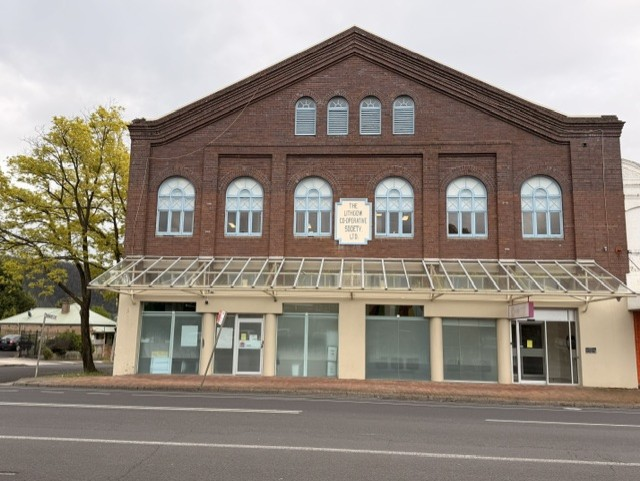

Railway Parade in Lithgow preserves an unusually concentrated streetscape of cooperative and labour history. The principal Lithgow Co-operative Building opened in stages from 1906 and was remodelled in 1920; nearby stand the former cooperative bakery and pharmacy building, the 1912 Trades Hall and union offices dating from 1928. Together they document the material presence of a consumer cooperative established in 1901 and of organised labour in an important New South Wales industrial town.
The original cooperative ceased trading in 1980, yet the disappearance of the enterprise did not erase its built legacy. Local heritage listing, surviving signage, archives held by Lithgow City Library, interpretive material and community research protect the historical meaning of structures now adapted to other uses. The group is especially valuable because it allows cooperation to be read at the scale of the town: commerce, labour organisation, meeting space and mutual provision remain visible within one urban corridor.
At its height the Lithgow Co-operative counted thousands of members, and the surrounding Trades Hall complex reflected the close, though distinct, histories of cooperative and labour organisation. The surviving buildings therefore document how working communities created institutions through which purchasing power, meeting space and representation could be organised collectively.
Their peace relevance lies in this democratic infrastructure. Industrial towns have often been sites of sharp economic conflict; cooperatives, unions and public meeting halls provided structured ways for people to organise interests, bargain, educate one another and participate in civic life. The buildings should not be romanticised as conflict-free spaces, but their continued preservation reminds us that peaceful industrial relations and social progress depend on institutions in which collective voice can be expressed rather than suppressed.
Featured Criteria
Criterion 1. Historical Significance
Sites must be at least thirty (30) years old, preferably sixty (60), or directly associated with foundational events, milestones, or figures in the cooperative movement.
Criterion 3. Archival, Architectural, or Symbolic Value
Represents milestones in cooperative development. Preserves stories, traditions, or knowledge tied to cooperative evolution.
Criterion 11. Visibility and Symbolism
Sites shall enhance the visibility of cooperation in public spaces through monuments, plaques, murals, and symbolic interpretation integrated within broader heritage narratives.