
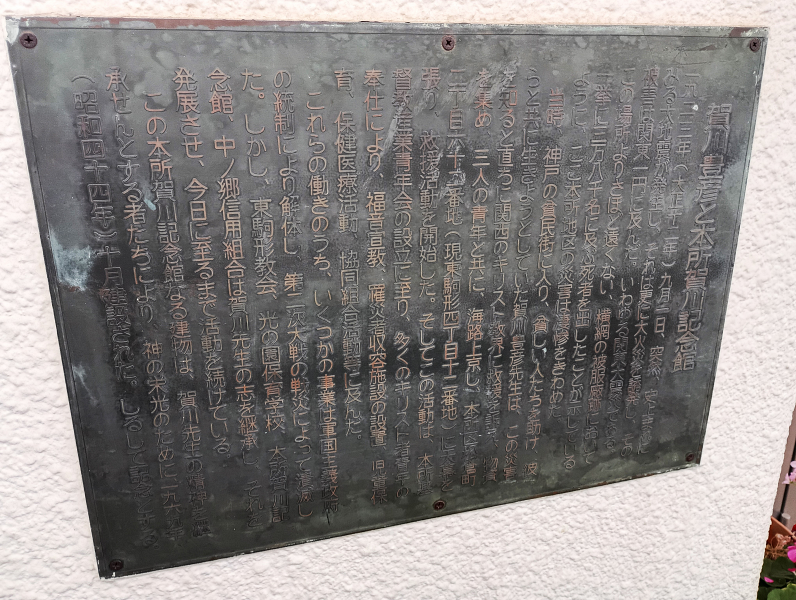

The Honjo Kagawa Memorial Center in Tokyo stands within the area where Toyohiko Kagawa undertook relief and settlement work after the Great Kanto Earthquake of 1923. Around that work developed a network of social initiatives including a clinic, childcare, adult learning and cooperative institutions such as the Koto Consumers' Union and the Nakanogo Pawn Co-operative. Much of the original physical environment was destroyed in the 1945 air raids, and the present Center dates from 1969. Its heritage is therefore carried less by architectural continuity than by continuity of purpose. Community welfare and children's programmes remain central, while regular reading groups and study sessions transmit Kagawa's ideas to staff, local participants and related organisations.
The site is significant as an example of 'spiritual' or institutional safeguarding: a place rebuilt after destruction has maintained the social-service and educational ethos associated with the cooperative and settlement movements that preceded it.
The Honjo site is directly connected with Kagawa's relief work after the Great Kanto Earthquake of 1923 and the settlement activities that followed. Institutions established in that environment included welfare, educational and cooperative initiatives, while the current Center, rebuilt in 1969 after wartime destruction, continues community and children's services.
The site emanates neighbourly love, service to community and commitment to peace as part of the guiding philosophy transmitted through study groups and organisational practice. Here the peace connection should therefore be explicit. The site's heritage lies in rebuilding social infrastructure after catastrophe: care, education, credit and community organisation were treated as mutually reinforcing. It demonstrates a conception of peace in which reconstruction means more than restoring buildings - it means restoring relationships, services and human dignity.
Featured Criteria
Criterion 1. Historical Significance
Sites must be at least thirty (30) years old, preferably sixty (60), or directly associated with foundational events, milestones, or figures in the cooperative movement.
Criterion 2. Connection to Cooperative Pioneers or Communities
Sites must demonstrate a tangible link to cooperative pioneers, enterprises, federations, or communities that shaped cooperative practice and identity.
Criterion 6. Educational Mission
Sites shall actively promote cooperative literacy through exhibitions, archives, guided tours, and programmes that teach the ICA Statement on the Cooperative Identity.