
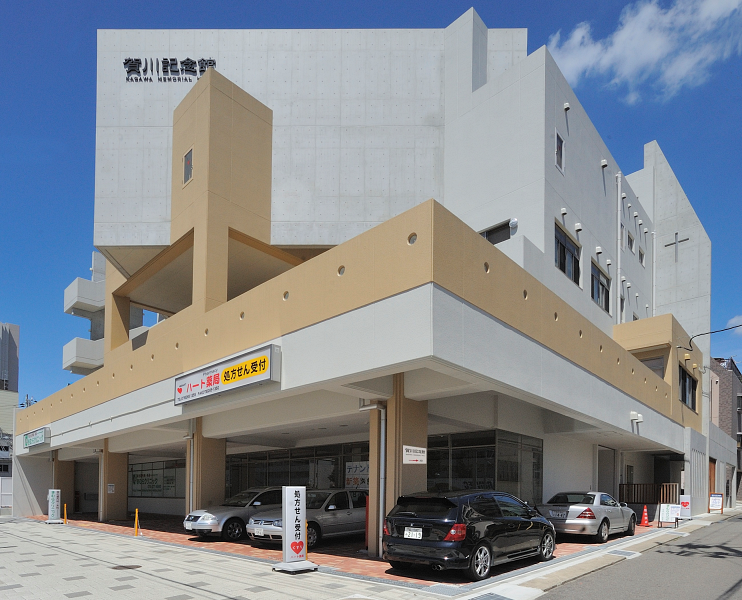

The Kagawa Memorial Center in Kobe occupies the area where Toyohiko Kagawa began the social work that would shape his later engagement with cooperation, welfare and peace. A memorial centre was first constructed there in 1963; the current building was completed in 2010 as part of the centenary commemorations of Kagawa's early work in Kobe. The complex deliberately combines interpretation with service.
Exhibitions and audiovisual material on Kagawa share the building with a church, childcare and education facilities, a clinic and a cafe whose name recalls an earlier dining initiative associated with his settlement work. Volunteers and cooperative members contribute to interpretation, and the Center is used for learning by visitors from Japan and abroad. Its significance lies in this coexistence of memory and social function: historical interpretation is embedded within institutions that continue to address community needs rather than being isolated in a stand-alone memorial.
The Kobe Kagawa Memorial Center stands in the area where Kagawa began social activity among poor communities. The current building, completed in 2010, combines exhibitions with a church, childcare and education facilities, a clinic and a cafe, preserving the settlement-house idea as an active social environment rather than a closed museum.
Cooperative members and local residents participate as volunteers and storytellers, while the Center is used for human-rights education and receives visitors from abroad. Its relevance to peace lies in this integration of memory and service. Poverty, exclusion and discrimination are treated not as abstract historical subjects but as continuing social questions requiring care, education and organised solidarity. The Center therefore embodies a peace ethic in which community welfare, human rights and cooperation are practical obligations.
Featured Criteria
Criterion 2. Connection to Cooperative Pioneers or Communities
Sites must demonstrate a tangible link to cooperative pioneers, enterprises, federations, or communities that shaped cooperative practice and identity.
Criterion 3. Archival, Architectural, or Symbolic Value
Represents milestones in cooperative development. Preserves stories, traditions, or knowledge tied to cooperative evolution.
Criterion 6. Educational Mission
Sites shall actively promote cooperative literacy through exhibitions, archives, guided tours, and programmes that teach the ICA Statement on the Cooperative Identity.
Learn More