
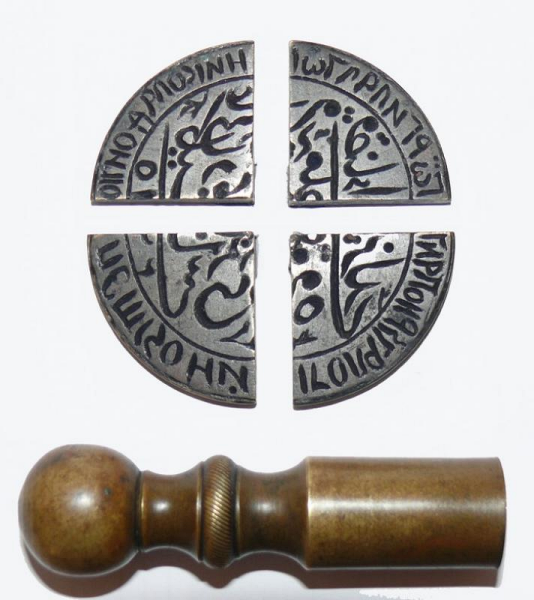

The Mirkovo Vakif Seal, preserved in Bulgaria's National Cooperative Museum, is a small artefact with an unusually powerful institutional logic. The seal bears Arabic characters and is constructed from five interdependent parts: four pieces form the circular seal and a handle joins them. According to the nomination, each participant held a corresponding part, so the seal could be used only when the group came together and agreed.
Its significance to cooperative heritage lies precisely in this material requirement for collective presence. Authority was not embodied in one individual's possession; the object functioned only through assembly and consent. Preserved, documented and interpreted by the National Cooperative Museum and the Central Cooperative Union, the seal connects older traditions of communal responsibility in Mirkovo with later cooperative values of trust, participation and shared accountability. It is an exceptional example of an object whose physical design itself communicates a principle of collective governance.
The seal's mechanism offers perhaps the most concise material metaphor for peaceful governance in the entire register. No holder could exercise the authority represented by the seal alone; effective action required the parts to be brought together. Whether read historically or symbolically, that structure places consent and interdependence at the centre of legitimate decision-making.
In relation to peace, the lesson is not that consensus is always easy, but that authority can be designed so that unilateral action is impossible. Museums often explain governance through texts and constitutions; the Mirkovo seal does so through an object that physically requires cooperation. Its preservation therefore allows visitors to encounter a tangible principle of peace: shared power obliges participants to meet, communicate and reach sufficient agreement to act.
Featured Criteria
Criterion 1. Historical Significance
Sites must be at least thirty (30) years old, preferably sixty (60), or directly associated with foundational events, milestones, or figures in the cooperative movement.
Criterion 3. Archival, Architectural, or Symbolic Value
Represents milestones in cooperative development. Preserves stories, traditions, or knowledge tied to cooperative evolution.
Criterion 11. Visibility and Symbolism
Sites shall enhance the visibility of cooperation in public spaces through monuments, plaques, murals, and symbolic interpretation integrated within broader heritage narratives.