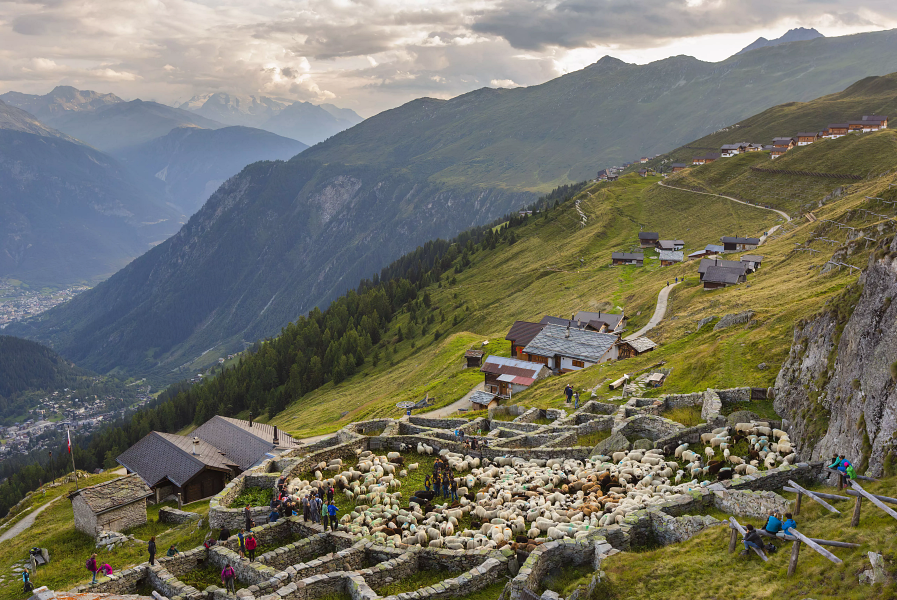

Switzerland’s alpine pasture season is the annual movement of cattle, sheep and goats to high-altitude pastures, together with the knowledge, skills and social practices required to maintain that seasonal economy. Alpine farmers care for animals, repair fences and buildings, manage pastures, process milk into cheese and other products, and welcome visitors. The practice has also generated rituals, festivities, specialist clothing and local forms of social exchange.
The official inscription text explicitly identifies alpine societies and cooperatives as bearers and transmitters of this knowledge. It states that farming and cheesemaking skills are often passed on informally within families and seasonal workforces, but also among members of alpine societies and cooperatives.
The inscription decision likewise includes cooperatives among the communities and organisations that sustain the element and notes their role in education and transmission. The cooperative connection is therefore not an analogy imposed from outside; it is part of the institutional ecology of the practice. This matters because alpine grazing is inherently interdependent. Access to high pastures, maintenance of routes and buildings, animal care, milk processing and landscape management all require rules and reciprocal obligations that extend beyond a single household.
Cooperative and associative structures help organise those responsibilities and keep knowledge connected to viable livelihoods. The alpine pasture season thus demonstrates how collective organisation can sustain fragile mountain environments and intergenerational continuity at the same time. The element’s relevance to peace is found in everyday reciprocity: shared resource use works only when participants accept legitimate rules, respect one another’s obligations and preserve a social relationship strong enough to manage common landscapes together.
Featured Criteria
Criterion 5. Living Practice of Cooperation
Sites shall embody cooperation as a living tradition, encouraging participation, democratic practice, and mutual aid, beyond static commemoration.
Criterion 8. Community and Member Engagement
Sites shall be embedded within their communities, ensuring active participation, ownership, and collective stewardship by local members and residents.
Criterion 10. Preservation and Safeguarding
Sites shall commit to the safeguarding of cooperative records, artifacts, oral traditions, and buildings through sustainable conservation strategies.