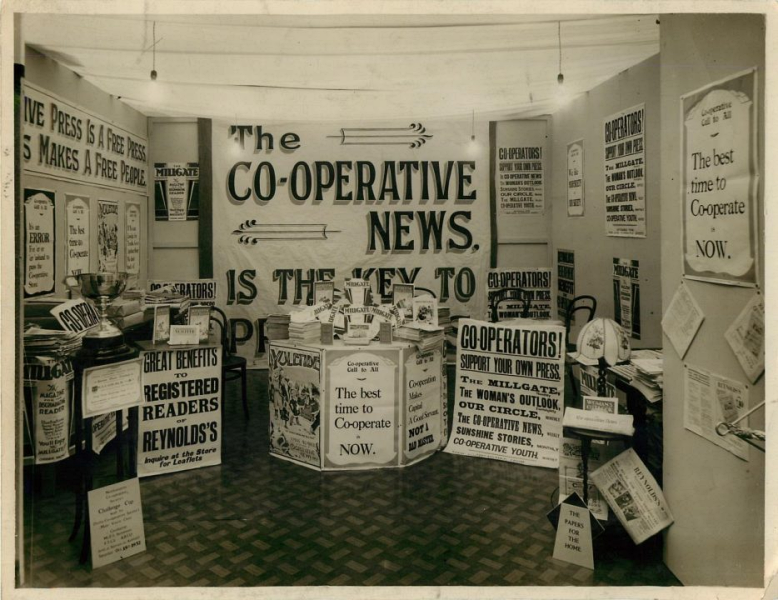

First published on 2 September 1871, Co-op News represents an unusual form of cooperative heritage: an archival record that is still being created. The newspaper emerged from demands within the British cooperative movement for an independent means of circulating information, debating policy and connecting societies. Across more than a century and a half, its pages have documented changes in retail, production, finance, housing, agriculture, politics and cooperative organisation in Britain and internationally.
The surviving archive provides a longitudinal record of the movement, while the practice of specialist cooperative journalism is transmitted through successive generations of editors and reporters. Today the title is published by Co-operative Press Ltd, itself a multi-stakeholder cooperative. That ownership structure gives the heritage an institutional continuity as well as an editorial one: the publication remains accountable to members while reporting on, interpreting and scrutinising the movement whose history it records.
The complete historical run is preserved through the Co-operative Heritage Trust, while the current publication remains owned by Co-operative Press Ltd, a cooperative accountable to member-subscribers. That governance structure matters because the publication's heritage is not simply the age of the title; it is a tradition of movement journalism that can celebrate achievement while scrutinising governance failures. Peaceful democratic systems need informed publics and credible spaces for disagreement.
Co-op News contributes to that culture by connecting cooperatives across borders, placing local experience in wider context and making debate visible. Its relevance to peace therefore lies in communication, accountability and plural exchange: a movement that can report on itself critically is better equipped to resolve tensions through evidence and argument rather than silence, faction or coercion.
Featured Criteria
Criterion 3. Archival, Architectural, or Symbolic Value
Represents milestones in cooperative development. Preserves stories, traditions, or knowledge tied to cooperative evolution.
Criterion 4. Active Cooperative Connection
Sites must either remain in operation as cooperatives or be explicitly dedicated to preserving and interpreting cooperative history.
Criterion 7. Research and Knowledge Sharing
Sites shall contribute to cooperative research and knowledge dissemination, in collaboration with universities, archives, and digital platforms.
Learn More