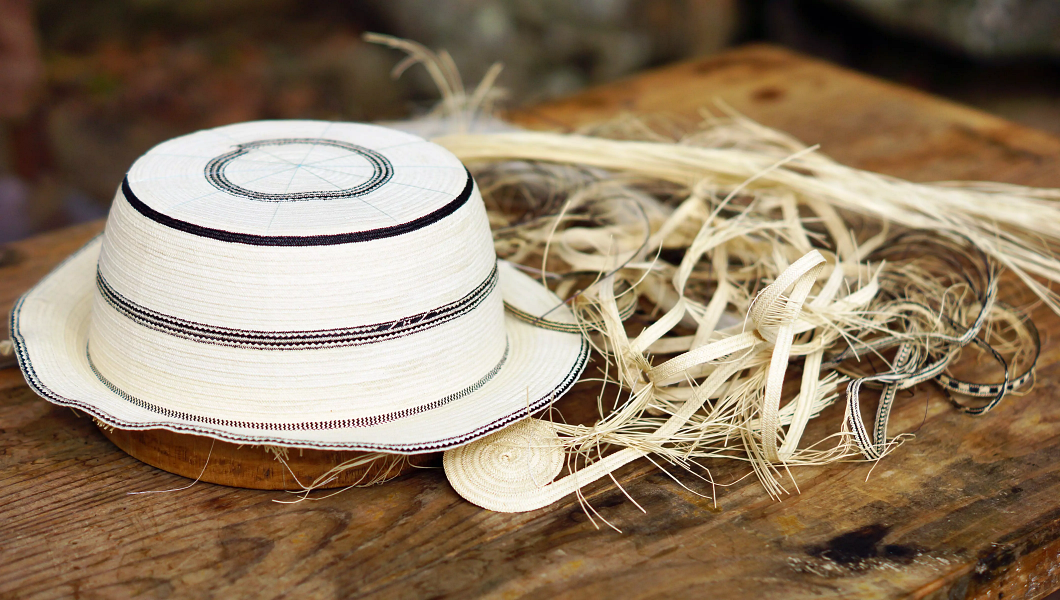

The artisanal processes used to make Panama’s pinta’o hat encompass the cultivation and preparation of plant fibres, the weaving of braids, talcos and pintas, and the assembly of a nationally recognised item of dress.
Knowledge is distributed across a chain of participants who grow plants, process raw material, weave and finish the hats. The tradition is transmitted from generation to generation and is reinforced through markets, competitions, public celebrations and the Pinta’o Hat Museum in La Pintada.
UNESCO states that the tradition promotes solidarity because artisans and plant suppliers are encouraged to form cooperatives and groups. This is an important recognition of the social structure required to keep the craft viable. The hat is not produced by a single isolated skill: the continuity of the element depends on relationships between growers, processors, weavers and sellers, and cooperation can give those actors greater capacity to organise materials, training and access to markets.
The pinta’o hat offers a particularly clear example of an intangible tradition whose safeguarding can be strengthened through collective enterprise. Cooperative organisation helps practitioners convert dispersed individual skills into a more resilient production ecosystem while preserving the cultural meanings attached to the object.
The same arrangement can reinforce social cohesion because it creates practical reasons for artisans and suppliers to collaborate across stages of production. In this way, the heritage embodies solidarity not only symbolically, through an object worn in national and community life, but institutionally, through the forms of organisation encouraged among the people who sustain it.
Cooperation as a means of safeguarding
An important expression of this collective approach can be found in the Cooperativa de Servicios Múltiples Artesanías Sombrero Pinta'o del Norte de Penonomé, R.L., based in the northern area of Penonomé in the province of Coclé. The cooperative brings the principles of cooperation into the safeguarding and economic life of the artisanal tradition surrounding the Pinta’o Hat.
The significance of the cooperative extends beyond the production or commercialisation of a traditional object. The Pinta’o Hat depends upon a living body of knowledge: knowledge of the plants and fibres, their preparation, the intricate techniques of braiding and weaving, and the cultural meanings transmitted through the craft. By organising artisans collectively, the cooperative provides a democratic and participatory structure through which this knowledge can be practised, shared and carried forward.
This cooperative dimension is particularly important for the safeguarding of intangible cultural heritage. Cultural traditions remain alive when their practitioners have the social and economic conditions necessary to continue them. Cooperative organisation can strengthen the position of artisans, facilitate access to markets and materials, encourage the sharing of skills and knowledge, and enable communities themselves to participate in decisions concerning the future of their cultural practice. In this sense, cooperation becomes not merely a means of producing the Pinta’o Hat, but a means of sustaining the community of knowledge that gives the hat its meaning.
The Cooperativa de Servicios Múltiples Artesanías Sombrero Pinta'o del Norte de Penonomé, R.L. therefore illustrates the close relationship between intangible cultural heritage, democratic participation and sustainable development. It demonstrates how a cooperative enterprise can provide an institutional home for a cultural practice: enabling artisans to pursue livelihoods while collectively safeguarding knowledge inherited across generations.
Its experience also gives practical expression to the solidarity associated with the Pinta’o Hat tradition. The heritage resides not only in the finished hat, but in the relationships among the people who cultivate, prepare, weave, teach, exchange and transmit its knowledge. Through cooperation, those relationships acquire an organised and democratic form—helping ensure that this distinctive expression of Panamanian cultural heritage remains a living practice rather than simply a memory of the past.This wording is consistent with the current CCH entry, which describes the tradition as depending on relationships among growers, processors, weavers and sellers. It is also supported by IPACOOP's official reporting, which specifically identifies the S/M Artesanías Sombrero Pinta’o del Norte de Penonomé, R.L., while Panama's Ministry of Culture describes cooperation with IPACOOP to organise artisanal groups and develop productive and innovative collective enterprises.
Featured Criteria
Criterion 5. Living Practice of Cooperation
Sites shall embody cooperation as a living tradition, encouraging participation, democratic practice, and mutual aid, beyond static commemoration.
Criterion 10. Preservation and Safeguarding
Sites shall commit to the safeguarding of cooperative records, artifacts, oral traditions, and buildings through sustainable conservation strategies.
Criterion 12. Sustainability and Inclusivity
Sites shall embody cooperative values of social and environmental sustainability, including, gender equity, youth engagement, and cultural diversity.